The Claroty Platform powered by Claroty Claire™ — the industry's first CPS-native AI agent — hardens transportation operations against cyber threats to protect the critical cyber-physical systems (CPS) on which the safety, security, and mobility of our society depend. By delivering deep visibility across control rooms, ports, terminals, railway lines, logistics hubs, pipelines, and vessels, Claroty unifies security governance, secures high-value operational networks, and eliminates costly operational downtime.
Digital transformation in the global transportation sector is accelerating to increase productivity and automate manual tasks. However, enterprise-wide cloud migrations, AI-driven threats, and the integration of modern internet-connected cyber-physical systems (CPS) are exponentially expanding the attack surface. Because operations across aviation, rail, maritime, pipelines, and logistics still rely considerably on legacy, unpatchable OT infrastructure, facilities and fleets have become high-value targets for ransomware and state-sponsored cyberattacks. Contending with these complex business, environmental, and geopolitical pressures includes the following critical transportation challenges:
Unpatched, legacy systems in control rooms, terminals, and vessels can’t be easily updated or replaced due to expensive capital costs and catastrophic operational downtime.
Ransomware threats frequently compromise IT or cloud environments and move laterally into OT networks — halting pipeline flows, shutting down port container terminals, and disrupting global flight planning systems.
Broadly distributed operational networks and regional infrastructure lead to fragmented security governance, uncontrolled remote access, and incomplete asset inventories across locations.
Governments worldwide are enforcing strict critical infrastructure mandates, including the NIS2 Directive, TSA Security Directives, SOCI Act, CISA Cross-Sector CPGs, and USCG MTSA requirements.
Generic IT security tools lack operational context and proprietary protocol coverage, creating severe blind spots and risking operational disruption if applied directly to fragile OT hardware.
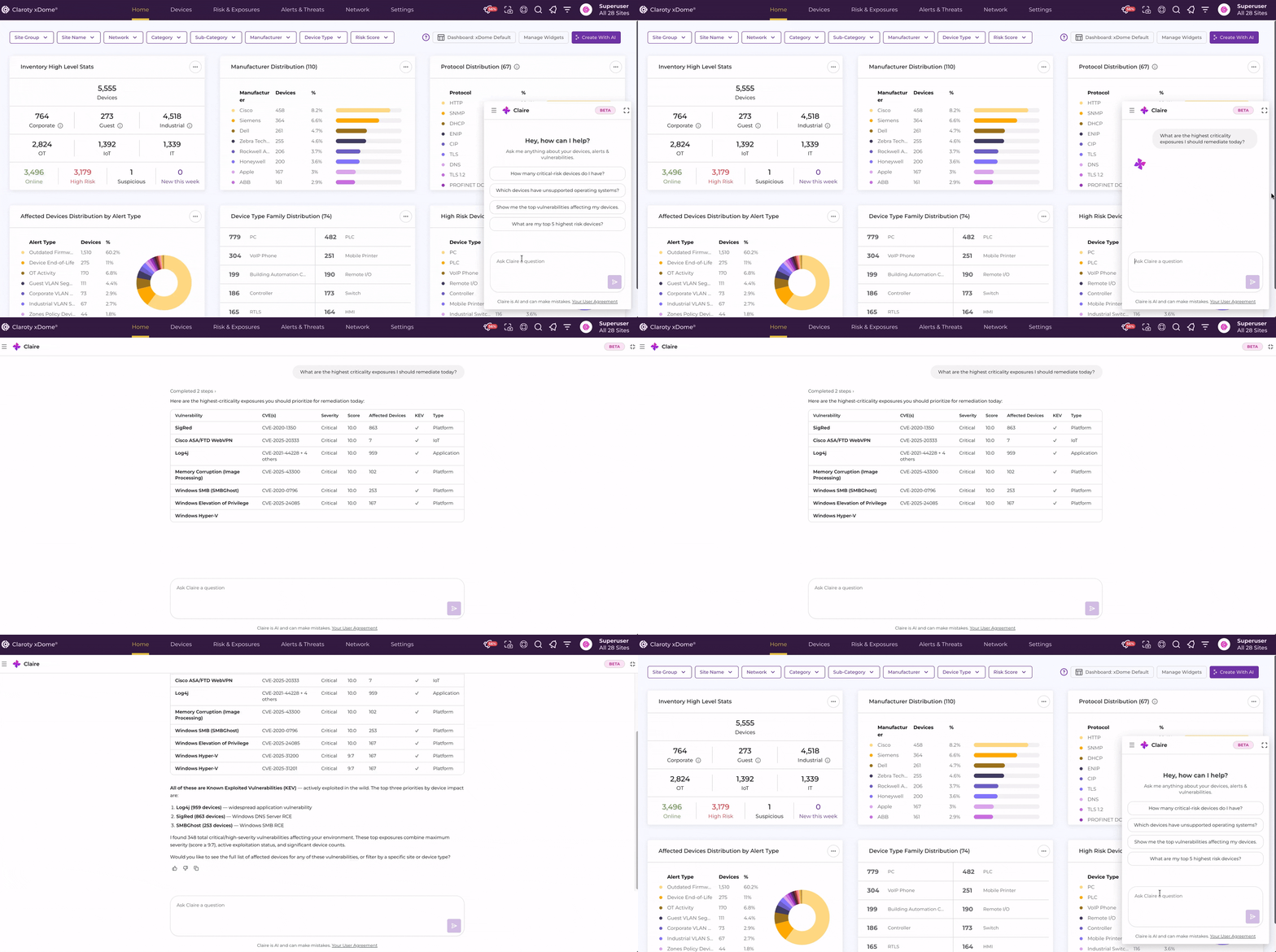
In this guided session, you'll discover how xDome provides comprehensive visibility and business context for all cyber-physical systems in your connected building environment.
Claroty delivers unmatched visibility and protection across automated baggage handling, signalling networks, SCADA control systems, shipboard automation, and terminal gantry cranes to safeguard the CPS that keep global commerce and passenger transit moving.
Unify Security Governance & Operational Teams: Establish clear, standardized risk metrics and communication workflows between your SOC and field engineers to accelerate incident response without compromising passenger safety or route scheduling. Claroty's embedded AI acts as a single source of operational truth, translating complex technical alerts into safe, optimized operational workflows.
Isolate Critical Operational Environments: Separate high-value navigation systems, rail signalling, and pipeline SCADA loops from corporate IT networks to mathematically block a ransomware breach from moving laterally. Claroty accelerates network defense using AI-powered asset zones and policy groups to enable virtual segmentation.
Mitigate Unknown Operational Risks: Rapidly profile all CPS devices, industrial sensors, and logic controllers to eliminate technical blind spots and uncover active exposures before they manifest as costly logistics bottlenecks or service stoppages.
Disruption-free Asset Discovery: Map every OT, IoT, and BMS asset across globally distributed ports, lines, airports, and hubs without shipping hardware appliances, deploying local software, or scheduling intrusive service disruptions. Claroty's AI-driven platform leverages the industry's largest CPS protocol library to provide precise identification of any device.
Purpose-Built Remote Access: Eliminate risky third-party vendor VPNs with a Zero Trust remote access solution engineered specifically for industrial personnel, enabling secure, real-time, time-bound, and fully audited remote maintenance interactions.
Compensating Controls for Legacy Infrastructure: Extend the life of aging, unpatchable control systems by surrounding them with precise behavioral monitoring and strict, automated zone-based policy simulation. Claroty maps device profiles and surfaces AI-driven recommendations via Exposure Management.
Automated Regulatory Reporting: Map facility-level and fleet CPS devices directly to mandatory frameworks such as TSA Security Directives, NIS2, SOCI Act, NIST CSF, and ISA/IEC 62443 to generate audit-ready reporting templates in minutes.
Operational Supply Chain Protection: Continuously monitor third-party connections, data exchanges, and remote vendor interactions to prevent supply chain compromises and ensure continuous operational availability.
Board-Ready Business Metrics: Translate complex CPS vulnerabilities into clear, context-rich risk scores, equipping executive leadership with the justification needed to back critical operational security investments. Claroty enables you to build dashboards and reports using natural language queries.
Domain-Specific AI: Trained on over a decade of CPS data and Team82 research, Claire thinks in operational terms and understands physical process context.
Context over Noise: Eliminates alert fatigue by answering "What should I do next?" with prioritized, high-precision recommendations.
Human-in-the-Loop Safeguards: Engineered specifically for fragile industrial environments, Claire ensures safe remediation actions that never induce unplanned downtime.
“Threats targeting national critical infrastructure are on the rise, so our rail system is in the crosshairs. Plus, with unmanned metro trains in our near future, we need to expand automation and connectivity, securely. We can’t spend years trying to apply IT security approaches that aren’t effective and put our safety compliance at risk. We were impressed with Claroty’s passive integration with switches, firewalls, and data diodes and their ability to provide us immediate asset visibility and continuous threat monitoring with no impact to our SIL certification.”
Mass Rapid Transit System & Claroty Customer
Transportation CPS security involves protecting the operational technology (OT), industrial control systems (ICS), and connected devices that drive global transport infrastructure. This extends beyond standard IT networks to shield specialized assets, including airport passenger terminal climate controls, baggage sortation lines, rail signalling and switch controllers, marine vessel automation systems, pipeline SCADA systems, and port container gantry cranes.
In transportation networks, corporate IT, shipment tracking, and scheduling tools are intertwined with OT environments. Cyberattackers often breach IT via phishing or unmonitored vendor connections and transfer laterally into OT. Once inside, malware can lock control room interfaces or manipulate SCADA configurations, forcing operators to halt pipeline pumping, close port container terminals, or ground airline fleets to ensure physical safety.
Claroty utilizes flexible, SaaS-driven discovery models and specialized collection methods that integrate directly into your existing network infrastructure and CMDB platforms. Bypassing the need to ship heavy hardware appliances or schedule maintenance outages, Claroty delivers a real-time, unified inventory of all CPS assets across global locations within hours.
Yes. Replacing critical, capital-intensive control hardware simply because it can’t tolerate software patches is operationally and financially unfeasible. Claroty changes the paradigm by providing virtual segmentation, continuous threat detection, and automated policy enforcement that isolate and protect legacy devices natively on the network wire without needing direct endpoint modifications or downtime.
Global regulatory bodies legally mandate strict cybersecurity oversight for critical infrastructure sectors. Claroty automatically discovers CPS assets, continuously monitors networks for threats, enforces Zero Trust remote access, and maps facility configurations directly to TSA Security Directives, the NIS2 Directive, SOCI Act, and NIST CSF — generating dynamic, audit-ready compliance reporting.